
Fields in Walton County Tax Records
Two offices shape what a parcel owes. The Board of Tax Assessors values property and administers exemptions, while the Tax Commissioner handles billing and collection, so read both records for the same parcel and year.
| Field | What It Shows | Where |
|---|---|---|
| Assessed value | Ordinary tax basis at 40 percent of market value | Tax Assessor |
| Fair market value | County estimate as of January 1 | Tax Assessor |
| Exemptions | Relief or special treatment applied | Tax Assessor |
| Tax bill & status | Amount, due date, payment, and delinquency | Tax Commissioner |
| Taxing districts | County, city, school, and other portions | Assessment and bill |
QPublic often breaks value into land, improvements, and accessories. One mill equals one dollar per $1,000 of assessed value. The bill is not a sale appraisal, and the person it names does not prove title.
Search Walton County Tax Assessments
Searches on the Walton QPublic portal run by owner name, location address, parcel number, or legal information. Exact-match controls tighten the address and owner modes, and an address range can pull up several parcels along one road.
| Field | Format | Use |
|---|---|---|
| Owner Name | Text, optional exact match | Find roll accounts |
| Location Address | Address or range | Locate the situs |
| Parcel Number | County APN | Open one account |
| Legal Information | Subdivision or legal text | Find a tract after address change |
A single card can carry a lot of detail. Expect annual previous, land, improvement, accessory, and current values, along with homestead, district, millage, acres, sales, and deed references. The assessment figure comes from the current certified roll, and the county can revise it, so treat what you see as subject to change.
Walton County's Forty Percent Rule
Walton County sets ordinary assessed value under a state rule. It equals 40 percent of fair market value. The market estimate carries a January 1 date. That date does not mean every owner or value field refreshes daily.
Land in qualifying agricultural use may get a 30 percent preferential assessment instead. County material describes a ten-year good-faith commitment tied to that treatment. It also notes a 2,000-acre statewide cap. A $25 recording fee applies as well. State-set conservation values cannot be appealed, though the fair market value stays on file. None of this reflects what the land would fetch at sale.
Walton County Homestead Filing Cycle
Tax returns and homestead forms generally follow a January 1 through April 1 filing window. Sensitive homestead filings go through an in-person process in Walton County. Exemptions can carry over while the same owner stays eligible. But county, city, and school effects differ. So verify each layer.
The Assessor sits at 303 S Hammond Drive, Suite 109, Monroe, and answers 770-267-1352. Always check the actual roll entry before drawing conclusions. Never infer an exemption from occupancy, mailing address, or owner name.
Look Up a Walton County Tax Bill
For the bill itself, the Walton County Tax Commissioner portal handles both lookup and payment. Start with a QPublic parcel number, then confirm owner, address, tax year, and district. Use only the controls the portal displays, since its field set can change.
- Save the APN, owner, district, and assessed value from QPublic.
- Search the Tax Commissioner record and choose the right year.
- Read the balance, due date, payment status, and district parts shown.
- Return to the assessment card to verify exemptions.
- Check the Clerk index for a recorded lien or tax-sale instrument when needed.
- Assessed value
- The base used under the applicable assessment program.
- Millage
- The levy per $1,000 of assessed value.
- Homestead exemption
- Relief granted when statutory ownership and occupancy rules are met.
- Tax lien
- A recorded claim tied to unpaid tax, distinct from a routine bill.
Walton County Tax Due Dates
Walton County mails tax bills in August, and payment is due November 15. Partial payments are allowed. Interest accrues once an account goes delinquent. Check the live bill for the exact date. Note any convenience fee before you submit payment online.
Delinquency is rarely the whole story. The Clerk can index many records on one parcel. These include a lien, a tax-sale deed, a sheriff's deed, a notice, an order, or a release. A court file may hold a challenge to the sale. A tax-sale deed differs from an ordinary warranty deed. Later redemption or correction records can matter to the owner of record.
Walton County Millage by District
Walton County property tax records show how millage stacks up by district. The 2023 county report set county M&O millage at 10.413. City portions came in at 6.467 for Monroe, 10.085 for Loganville, and 7.900 for Social Circle. Add those together and the city-plus-county totals were 16.880, 20.498, and 18.313, before any school components figured in.
Treat those numbers as dated context, not as your current tax bill. Every district line matters when you read a bill. A postal address alone never settles jurisdiction, either. Loganville spills into Gwinnett County, and Social Circle mapping can point toward Newton, so the parcel number, not the mailing city, tells you which tax roll applies.
Note: Before comparing two tax accounts, match the year, city status, school and fire components, exemptions, and any assessment program in the property records.
Walton County Digest Growth Context
Walton County's gross digest grew from roughly $3.285 billion in 2018 to $5.947 billion in 2023. That figure comes from the 2023 report. Exemptions climbed from about $509.788 million to $1.577 billion over the same span. Net digest rose from $2.776 billion to $4.370 billion. That shift reflects values, exemption changes, classes, and levies all moving together. It says nothing about a single parcel. For one account, pull the annual value parts in QPublic. Weigh a $0 or unqualified sale carefully. The tax digest archive rounds out the countywide history behind Walton County property tax records.
Walton County Property Tax Sales
A delinquent tax account and a recorded sale are different records. The Walton County Tax Commissioner account can show the bill year, amount, and status. It also lists the due date and any delinquency. The Clerk's deed index is separate. It lists instruments such as tax-sale deeds, sheriff's deeds, liens, notices, court orders, and releases. Superior Court records may hold a challenge or a quiet-title action tied to the parcel.
Hang onto the parcel number, tax year, and deed book and page. Keep the notice, plus any later release or redemption record. Read the full instrument before drawing conclusions. The assessor may keep a prior owner of record on the certified tax roll. That entry can stay until a later update. A tax-sale deed also reads differently than an ordinary warranty deed. That difference matters in Walton County property records.
Walton County Tax Office Access
Two offices share the building at 303 S Hammond Drive in Monroe. The Tax Assessor sits in Suite 109 and takes calls at 770-267-1352. The Tax Commissioner works from Suite 100 at 770-266-1736 and answers email at WCTC@co.walton.ga.us. Keep the desks straight. Assessment and exemption questions go to the Assessor. Bill and payment questions belong with the Tax Commissioner.
If the online portal leaves a question open, visit with a few things in hand. Bring the parcel number, the property address, and the owner of record spelling. Add the tax year and a copy of the notice or bill. Georgia's Open Records Act covers nonexempt offline files as well. An agency should answer within three business days with the records or an estimate of cost and time. It may instead cite the exemption it relies on.
Walton County Tax Portal Screen
For current bill access, the Tax Commissioner search page is the official Walton County property tax route.
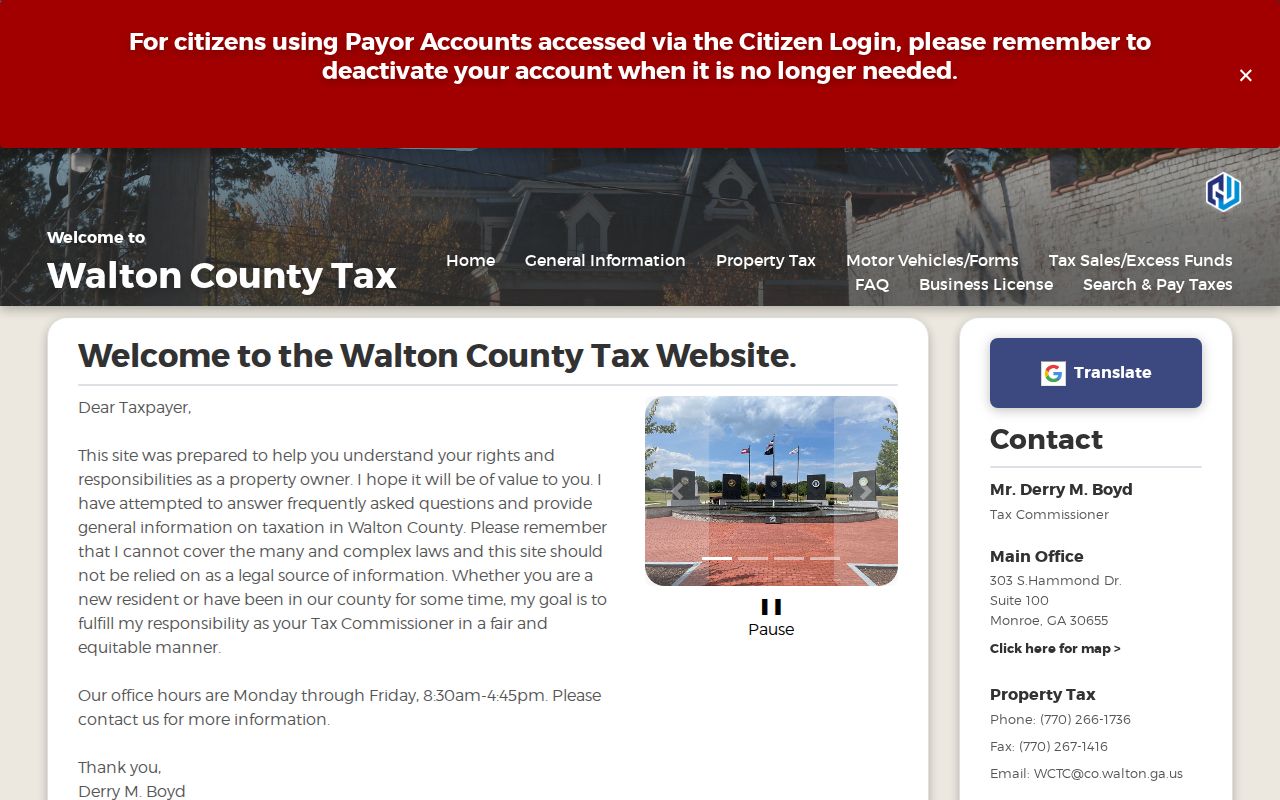
Once there, confirm the account, the tax year, and the payment state on the live page. The name on a bill is never proof of title.
Appeal a Walton County Assessment
Owners generally have 45 days from the assessment notice to file an appeal. Walton County names value, uniformity, taxability, and classification as the issues a taxpayer can raise. A dispute may move to the Board of Equalization or arbitration. A later path runs through Superior Court. Remember the split in duties. The Assessor handles the value fight; the Tax Commissioner handles the bill itself.
Strong proof makes the case easier. Gather the notice, the parcel card, prior value history, comparable records, photos, measurements, and use facts. Add any documents supporting an exemption or classification claim. Date each item and keep proof of filing.
Appeal window. File within 45 days of the assessment notice through the Walton County Tax Assessor process. Confirm the exact deadline printed on the notice.